Solution Architecture
June 11, 2026
How We Cut Application Development Time in Half Using Claude Code
How Accelerize 360 used Claude Code to reduce application development time, improve code quality, and accelerate delivery.

How Accelerize 360 used Claude Code to reduce application development time, improve code quality, and accelerate delivery.
When enterprise teams come to us, they're not looking for a technology conversation. They're looking to close the gap between where their systems are today and where their business needs them to be. Speed of delivery isn't a vanity metric — it's how quickly a client can start realizing value from the investment they've made. That's the lens we bring to every engagement, and it's why we're always looking for ways to get working software into our clients' hands faster without compromising quality.
Delivery timelines in enterprise application development are rarely limited by ideas. They're limited by execution — the grind of writing complex back-end classes, maintaining aging automation logic, keeping test coverage high enough to ship confidently, and managing deployments without breaking things. These aren't glamorous problems. They're the ones that quietly eat your sprint capacity week after week.
For our client Elite Insurance Partners, those pressures are compounded by the stakes. In financial services, code quality isn't just a best practice — it's a compliance requirement.
Elite Insurance Partners has been a long-standing client. Over the course of our partnership, we've taken on increasingly complex development work across their application portfolio. About a month ago, we integrated Claude Code directly into that active workflow. No sandbox experiment. No isolated proof of concept. We put it into a live engagement and measured what happened.
The results were clear enough that we're writing this post.
50–60% reduction in development time.
A complex back-end class that previously took 4 hours now takes around 1.5 hours. That's not incremental improvement — it's effectively doubling output on core coding tasks.
Beyond speed, the quality lift has been just as significant. We estimate Claude Code is catching 80–90% of security vulnerabilities and code optimization opportunities before work even reaches formal review. For a client operating in a regulated industry, that's not a nice-to-have. It changes the risk profile of every release.
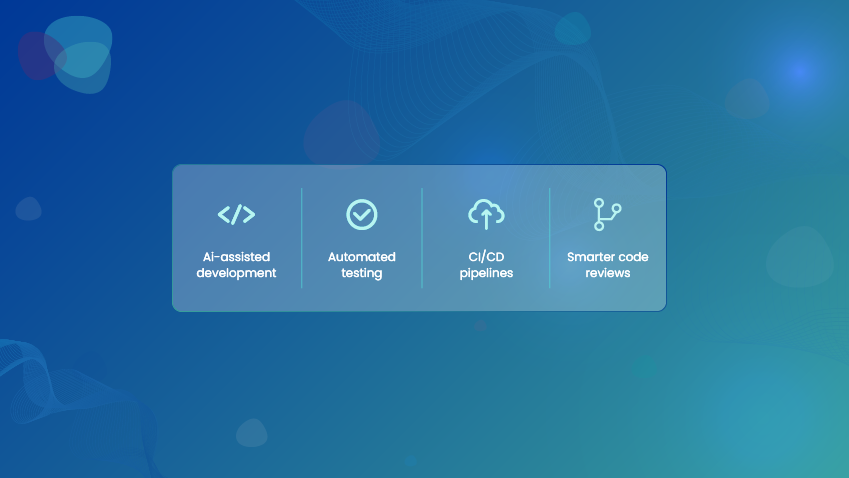
Every mature application accumulates automation debt — triggers and scheduled jobs built years ago that the native tooling can no longer safely migrate. We used Claude Code to manually work through some of EIP's most complex legacy automation logic, and it didn't just translate the code. It surfaced architectural best practices for the new implementation and identified bugs that had been sitting quietly in the existing logic. That kind of review used to require a senior developer dedicating focused time. Claude Code did it inline.
We connected Claude Code to the GitHub and application environments to test how it handled DevOps tasks end-to-end. Using plain natural language prompts, it committed code, created pull requests, and once approved, automatically pushed changes through to UAT and production environments. The human stayed in the loop at the approval gate. Everything else was handled.
Writing test classes for complex back-end code is one of those tasks developers dread for good reason — it's tedious, it's time-consuming, and doing it poorly creates false confidence. Claude Code automates the full loop: it writes the test, runs a dry run to check coverage, and if the percentage isn't where it needs to be, it goes back, analyzes the related classes, and rewrites until it hits the maximum achievable coverage. What used to be a half-day task is now something that runs in the background.
Generic productivity gains are one thing. In banking, insurance, and financial services, where audit trails, security posture, and code quality carry regulatory weight, the implications go further. Catching 80–90% of vulnerabilities before formal review doesn't just save time — it materially reduces exposure. Automated test coverage doesn't just ship faster — it documents correctness. These aren't separate benefits. They compound.
We're not suggesting Claude Code replaces engineering judgment. It doesn't. What it does is remove the friction between good thinking and working software, so your best developers spend more time on the problems that actually require them.
If you're running a development team and haven't yet explored what AI-assisted development looks like in a live production workflow, we'd be glad to walk you through what we're seeing—contact us to start the conversation.
Subscribe for the latest insights and blog updates. Stay ahead with us!
Subscribe Now