The Future of Lending: Faster Decisions Without Losing the Human Touch
Lending teams need to move faster, but borrowers still expect clarity, trust, and human guidance. Here’s how AI agents and trusted data can improve lending without making it feel less personal.
Lending Has a Speed Problem, But It Is Also a Trust Problem
Every lender wants to move faster.
And borrowers want that too. No one wants to wait days for a status update or wonder if their application is moving forward.
But lending is not just another transaction. Whether someone is applying for a mortgage, exploring a home equity loan, or trying to understand their options, the process can feel personal, emotional, and sometimes stressful.
That is why the future of lending is not only about speed.
It is about speed with clarity. Speed with confidence. Speed with trust. Speed with the right human support at the right moment.
As AI agents, automation, and trusted data become bigger conversations around Dreamforce 2026, lending leaders have an important opportunity: to reduce friction without removing the human touch that borrowers still need.
Why Lending Journeys Feel Slower Than They Should
Most lending teams are not slow because people are not working hard.
They are slow because the process has too many disconnected steps.
Borrower information may live in one system. Communication history may live somewhere else. Documents may be tracked manually. Follow-ups may depend on individual team members remembering what needs to happen next. Status updates may require someone to search across multiple tools before giving an answer.
The borrower sees delay.
The lending team feels pressure.
And the business loses momentum.
This is where technology can help, but only if it is solving the right problem. The goal should not be to automate every touchpoint. The goal should be to remove the unnecessary friction that slows people down.
That starts with better data, better workflow visibility, and smarter support for lending teams.
AI Agents Can Help, But They Need the Right Role
AI agents have the potential to change how lending teams work.
They can help summarize borrower status, surface missing information, suggest next steps, draft follow-ups, route inquiries, and support faster handoffs between teams.
For example, instead of a loan officer manually checking multiple systems to understand where a borrower stands, an AI agent could help summarize the current status, highlight what is missing, and recommend the next action.
Instead of a borrower waiting for a basic update, an agent could help provide a clear response based on approved data and business rules.
Instead of a team losing time on repetitive reminders, an agent could support document follow-up, appointment scheduling, or internal task creation.
But the key word is support.
In lending, AI should not feel like a wall between the borrower and the institution. It should feel like a better way to keep the process moving.
The best AI agents will not replace the relationship. They will help protect it by giving teams more time, better context, and clearer next steps.
Borrowers Still Need Human Confidence
A lending journey is full of questions.
Did you receive my documents? What happens next? Am I missing anything? How long will this take? Can someone explain what this means? Is this the right option for me?
Some of these questions can be answered quickly with the right data and workflow support. Others need human judgment, empathy, and explanation.
That is why the future of lending cannot be fully automated.
Borrowers want speed, but they also want to feel understood. They want answers, but they also want confidence. They want digital convenience, but they do not want to feel abandoned when the decision matters.
This is especially important when delays, missing documents, credit questions, income verification, exceptions, or complex financial situations come up.
AI agents can help teams see those moments sooner.
But people still need to step in when the conversation requires care.
Trusted Data Is What Makes Faster Lending Possible
Speed depends on data.
If borrower data is incomplete, duplicated, outdated, or spread across systems, even the best automation will struggle.
A lending team needs to know:
Who is the borrower?
Where are they in the journey?
What documents have been received?
What is still missing?
What was the last interaction?
Who owns the next step?
What needs human review?
What can be safely automated?
If that information is hard to find, the process slows down.
Trusted data gives both people and AI agents the context they need to act with confidence. It helps reduce repeated questions, missed follow-ups, unclear ownership, and poor handoffs.
This is why lending modernization is not only about adding AI. It is about building a stronger data foundation first.
At Accelerize 360, we see this across many transformation conversations. A better borrower experience usually depends on connected data, clean workflows, and teams that can see the full picture. That is where a strong Data, AI & Analytics strategy becomes essential.
What Faster Lending Can Look Like in Practice
Faster lending does not have to mean rushing the borrower.
It can mean creating a smoother, more transparent journey.
Here are a few practical examples.
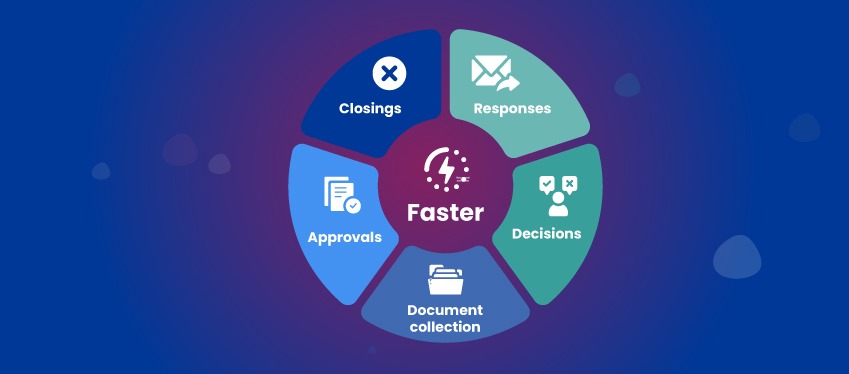
A borrower submits an inquiry. Instead of waiting for manual review, the system routes it to the right team and helps prioritize follow-up.
A loan officer opens the borrower record. Instead of searching across multiple tools, they see a clear summary of status, history, missing items, and recommended next steps.
A document is missing. Instead of someone manually tracking it in a spreadsheet, an automated reminder is triggered with clear instructions.
A borrower asks for an update. Instead of receiving a generic response, they get a timely answer based on where they are in the process.
A case needs human review. Instead of being lost in a queue, it is escalated with the right context attached.
These are the moments where AI and automation can make lending feel faster and more human at the same time.
Not because the borrower is speaking only to a machine, but because the people supporting them are better prepared, better informed, and less buried in manual work.
The Human Touch Should Be Designed Into the Workflow
Many institutions think about automation first and human involvement second.
In lending, that order should be reversed.
Start by identifying the moments where human judgment matters most.
Those may include:
Explaining loan options
Handling exceptions
Responding to borrower concerns
Reviewing complex financial situations
Building trust during uncertain moments
Helping borrowers understand next steps
Supporting decisions that need empathy and context
Once those moments are clear, teams can decide where AI agents and automation should assist.
This approach keeps the borrower experience balanced. It allows technology to handle repetitive, time-consuming, and information-heavy tasks, while people stay focused on the conversations where they add the most value.
That is what human-centered automation looks like.
Why Governance Matters in Lending
As AI becomes more involved in lending workflows, governance becomes even more important.
Lenders need to know what an AI agent can access, what it can recommend, what it can send, what it can trigger, and when it must escalate to a human.
This is not just a technical concern. It is a business and trust concern.
Governance helps protect the borrower experience. It helps teams stay aligned. It helps reduce risk. And it gives leaders more confidence when scaling AI across lending operations.
Important questions include:
Which borrower data can the agent use?
Which communications can be automated?
What requires human approval?
How are agent actions reviewed?
How are exceptions handled?
Who owns the workflow rules?
How do we measure whether the experience is improving?
The more AI supports real lending work, the more important these questions become.
A360 Perspective: The Best Lending Journeys Combine Speed, Context, and Care
At Accelerize 360, we believe lending transformation should not force a choice between efficiency and empathy.
The strongest lending experiences will combine both.
That means giving teams better visibility. Connecting borrower data across systems. Reducing repetitive manual work. Using AI agents where they can support speed and consistency. Keeping people involved where trust, judgment, and explanation matter most.
This is especially important as financial services organizations prepare for the next wave of Salesforce, Data 360, Agentforce, and AI-enabled workflows.
Solutions like Homer for Mortgage reflect this need for more connected borrower communication and Salesforce-powered lending experiences. And recent examples like our insight page, Home Equity Lending. Faster Closings. Lower Costs. Zero Record Locks, show why lending teams need systems that help work move without creating unnecessary friction.
The future of lending is not about making the process feel less human.
It is about making the human moments easier to deliver.
What Lending Leaders Should Ask Before Scaling AI
Before adding AI agents into lending workflows, leaders should take a practical look at readiness.
Start with these questions:
Where are borrowers waiting the longest?
Which steps create the most confusion?
Where are teams doing repetitive manual work?
What data do teams need but cannot easily access?
Which moments require human judgment?
Which updates or reminders can be safely automated?
What governance needs to be in place?
How will we measure a better borrower experience?
These questions help teams avoid using AI for the sake of AI.
They also help identify where AI can create real value without damaging trust.
AI Overview: The Future of Lending
The future of lending is about making borrower journeys faster, clearer, and more connected without removing the human support borrowers still need. AI agents can help lending teams summarize borrower status, identify missing documents, route inquiries, trigger follow-ups, and improve visibility across the journey. But success depends on trusted data, clear workflows, governance, and human oversight. The best lending experiences will use AI to reduce friction while keeping people involved in moments that require trust, empathy, and judgment.
Final Takeaway
Lending needs to move faster.
But faster should not mean colder. It should not mean confusing. It should not mean pushing borrowers through an automated process without support.
The future of lending is about helping teams make faster decisions with better context, stronger data, and clearer workflows.
AI agents can play an important role in that future. But they need trusted data, thoughtful governance, and a clear understanding of where humans should stay involved.
Because borrowers do not just want a faster journey.
They want a journey they can trust.
And the lenders that get this right will be the ones that use technology to strengthen the human experience, not replace it.
FAQs
How can AI agents help lending teams?
AI agents can help lending teams summarize borrower status, identify missing documents, route inquiries, draft follow-ups, trigger reminders, and provide employees with better context for faster decision-making.
Will AI replace loan officers?
AI should not replace loan officers. In lending, the better use of AI is to support loan officers by reducing manual work, improving visibility, and helping them focus on borrower conversations that need human judgment.
Why does trusted data matter in lending?
Trusted data matters because lending teams and AI agents need accurate, connected, and current borrower information to make decisions, provide updates, and support the journey with confidence.
What is human-centered automation in lending?
Human-centered automation means using technology to reduce friction and repetitive work while keeping people involved in moments that require trust, empathy, explanation, or judgment.
How can lenders prepare for AI agents?
Lenders can prepare by identifying high-friction workflows, improving data quality, connecting borrower information across systems, defining governance rules, and deciding which moments should remain human-led.
Want to Learn More?
Ready to make lending faster without losing the human touch?
Connect with Accelerize 360 to explore how trusted data, Salesforce strategy, and AI-enabled lending workflows can help your team create smoother borrower journeys.
Did you like what you read? Share it with the world :
Subscribe For Updates
Subscribe for the latest insights and blog updates. Stay ahead with us!