Financial institutions are operating in one of the most volatile and complex environments in recent memory. Economic uncertainty, heightened regulatory scrutiny, digital‑first competitors, and rapidly evolving customer expectations are reshaping the competitive landscape. In this environment, data has become the most valuable—and often the most underleveraged—asset.
Despite years of investment in analytics, cloud platforms, and digital transformation, many banks and credit unions still struggle to translate data into measurable business outcomes. The issue is not only the right technology. More often, it is the absence of a clear, executable data strategy that aligns to business objectives, prioritizes what matters most, and is supported by modern architecture and governance.
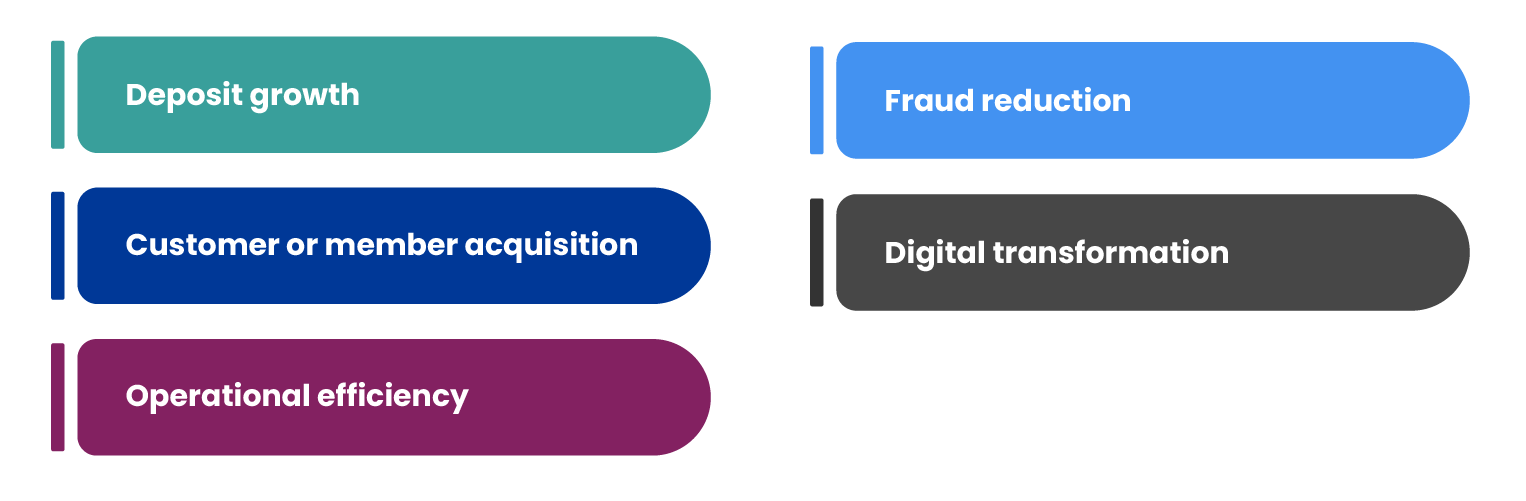
A strong data strategy begins with alignment to organizational objectives. Data initiatives must directly support enterprise goals such as:
When data strategy is treated as a business strategy—not a technology project—institutions are far more likely to achieve meaningful outcomes. This requires measurable KPIs, cross‑functional alignment, and a disciplined focus on use cases that deliver both near‑term ROI and long‑term capability building.
Understanding customers or members at a deeper level is another essential component. Personas have evolved from simple marketing tools into strategic assets that drive personalization, product design, and frontline engagement. To truly create the experience customers/ members demand, institutions must define personas that integrate:
Behavioral data
Transactional data
Psychographic data
...to create a more complete picture of customer/member needs and motivations. When personas are continuously validated and embedded across the organization, they become powerful drivers of loyalty, relevance, and growth.
Identifying high‑priority data and elevating data quality form the foundation of any successful strategy. Financial institutions must understand which data elements are most critical to their operations, risk posture, and customer experience. This requires:
Robust data lineage
Observability
Validation frameworks
Clearly defined ownership
Institutions that invest in data quality early are better positioned to scale analytics, accelerate audits, and build trust in data‑driven decisions.
A modern technology roadmap is equally essential. As cloud adoption accelerates and AI becomes more deeply embedded in financial services, institutions must ensure their architecture supports scalability, interoperability, and real‑time insights. Cloud‑first strategies, multi‑cloud environments, unified data platforms, and API‑driven ecosystems are becoming the norm. Data products are emerging as reusable building blocks that streamline analytics and reduce operational friction. The institutions that modernize their architecture thoughtfully—balancing innovation with risk—will be best positioned to compete.
Governance, risk, and compliance must be embedded throughout the strategy. With regulatory scrutiny increasing, institutions must ensure accuracy, traceability, privacy, and security across their data ecosystem. Model risk management is becoming especially important as AI adoption grows. Strong governance not only reduces risk but also accelerates decision‑making and strengthens organizational trust in data.
Execution, however, is where many strategies falter. A strong data strategy must be supported by:
Institutions with clear execution roadmaps consistently outperform those with fragmented or ad‑hoc approaches.
Finally, enabling AI with trusted, well‑governed data is becoming a defining capability. As institutions continue the methodical transition to AI it is imperative the underlying data is complete, consistent, and reliable. This means establishing:
Data observability
Domain‑specific quality frameworks
Transparent, explainable AI practices
Institutions that start with high‑value use cases—such as fraud detection, personalization, and risk scoring—can demonstrate early wins while building momentum for broader transformation.
In a market defined by disruption, financial institutions that treat data strategy as an enterprise‑wide transformation are pulling ahead. The leaders are aligning data to business outcomes, understanding customers deeply, modernizing their architecture, investing in governance, and enabling AI with trusted data. They recognize that data strategy is no longer a back‑office function—it is a competitive weapon. And in the years ahead, it will increasingly determine which institutions thrive and which fall behind.
At Accelerize 360, one of our big focuses is equipping community financial institutions with the right data strategy. To meet customer/member needs, to compete in a very crowded market, and the right data foundation becomes essential. In order to deliver the right customer insights and experience optimization, each institution must have access to accurate and connected data.
Accelerize can also help your institution with the following:
Organizational data strategy design
Persona development (consumer & business) as a foundation for personalization
Transactional vs. transformational interactions and how data enables both
Data infrastructure assessment
Data journey roadmap
AI preparedness review and recommendations
If your institution is navigating these challenges and evaluating what comes next, we invite you to connect with Accelerize 360. Let's discuss how the right data, insights, and strategy can help your organization remain resilient, customer-focused, and prepared for the future.
Did you like what you read? Share it with the world :
Subscribe For Updates
Subscribe for the latest insights and blog updates. Stay ahead with us!