Point of View
May 21, 2026
Transforming Financial Institution Marketing into a Strategic Tool
Financial institutions can turn marketing into a growth engine with smarter strategy, personalization, data insights, and measurable ROI.


Financial institutions can turn marketing into a growth engine with smarter strategy, personalization, data insights, and measurable ROI.
In today’s banking landscape- defined by margin pressure, shifting consumer expectations, and intensifying competition- marketing can no longer function as a support function. It must operate as a strategic growth engine. Yet many financial institutions still struggle to translate marketing activity into measurable business outcomes.
The institutions that are winning are those that treat marketing as a core component of their go‑to‑market strategy, tightly aligning it with business objectives, customer needs, and innovation priorities. Recent industry research underscores why this shift is urgent: banks and credit unions continue to face macroeconomic uncertainty, rising regulatory scrutiny, and the need to modernize digital experiences, all while navigating challenges that will persist into the future. At the same time, customer and member acquisition has become more complex as competition from direct banks and fintechs intensifies, marketing budgets tighten, and external events—from elections to global sporting events—drive up media costs and fragment attention.
To make marketing an effective growth tool, financial institutions must begin with alignment. A strong go‑to‑market strategy starts by connecting enterprise‑level business objectives directly to marketing strategy. This means defining the growth targets- whether deposit acquisition, loan growth, digital engagement, or wallet‑share expansion- and ensuring marketing is accountable for measurable contributions to those outcomes. Digital customer engagement continues to be a top strategic priority, reflecting a clear shift toward marketing‑led growth levers that influence both acquisition and retention. When marketing is positioned as a driver of enterprise strategy rather than a downstream executor, institutions gain clarity, focus, and the ability to prioritize investments that move the needle.
Defining the customer or member with precision is equally essential. Financial institutions that build robust personas- grounded in demographic, behavioral, and financial insights- are better equipped to identify the most productive markets and tailor their messaging accordingly. Understanding where potential customers are, how they behave, and what they need is the cornerstone of a successful acquisition strategy, especially as consumer preferences evolve and traditional triggers like residential moves decline. Personas also enable institutions to design next‑best‑action journeys that guide customers through personalized pathways across channels. These journeys are no longer optional; they are a competitive necessity in a world where customers expect seamless, relevant, and timely interactions.
Innovation becomes the multiplier. Collaboration across marketing, product, digital, and data teams allows institutions to create differentiated offerings that resonate with targeted segments. Finding the optimal balance of digital marketing spend to reach younger age demographics alongside more traditional media channels provides institutions new opportunities to reach audiences in more authentic and impactful ways. But innovation must be grounded in insight: understanding unmet needs, testing new value propositions, and rapidly iterating based on performance data.
Marketing must be relied on as a growth function- not just for sponsorships, community activities, or as an internal communication engine. Establishing specific ROI expectations tied to acquisition cost, conversion rates, product penetration, and lifetime value ensures the right expectations are set and enables smarter budget allocation. With heightened ROI expectations and shrinking budgets, financial institutions are under pressure to deliver more with less, making measurement discipline non‑negotiable.
Institutions that build closed‑loop measurement systems gain the ability to optimize campaigns in real time, justify investment, and demonstrate marketing’s direct impact on growth. For example, rather than running a generic, wide-net auto loan campaign, a closed-loop approach allows a credit union to instantly target existing members who recently engaged with an online auto-buying calculator- lowering acquisition costs while driving higher conversion.
The path forward is clear: financial institutions that elevate marketing into a strategic, insight‑driven, innovation‑oriented discipline will be the ones that grow in a challenging environment. By aligning business and marketing strategy, defining and deeply understanding the customer/member, prioritizing next‑best‑action journeys, collaborating to build offerings that matter, and establishing clear ROI expectations, marketing becomes more than a function—it becomes a catalyst for sustainable growth.
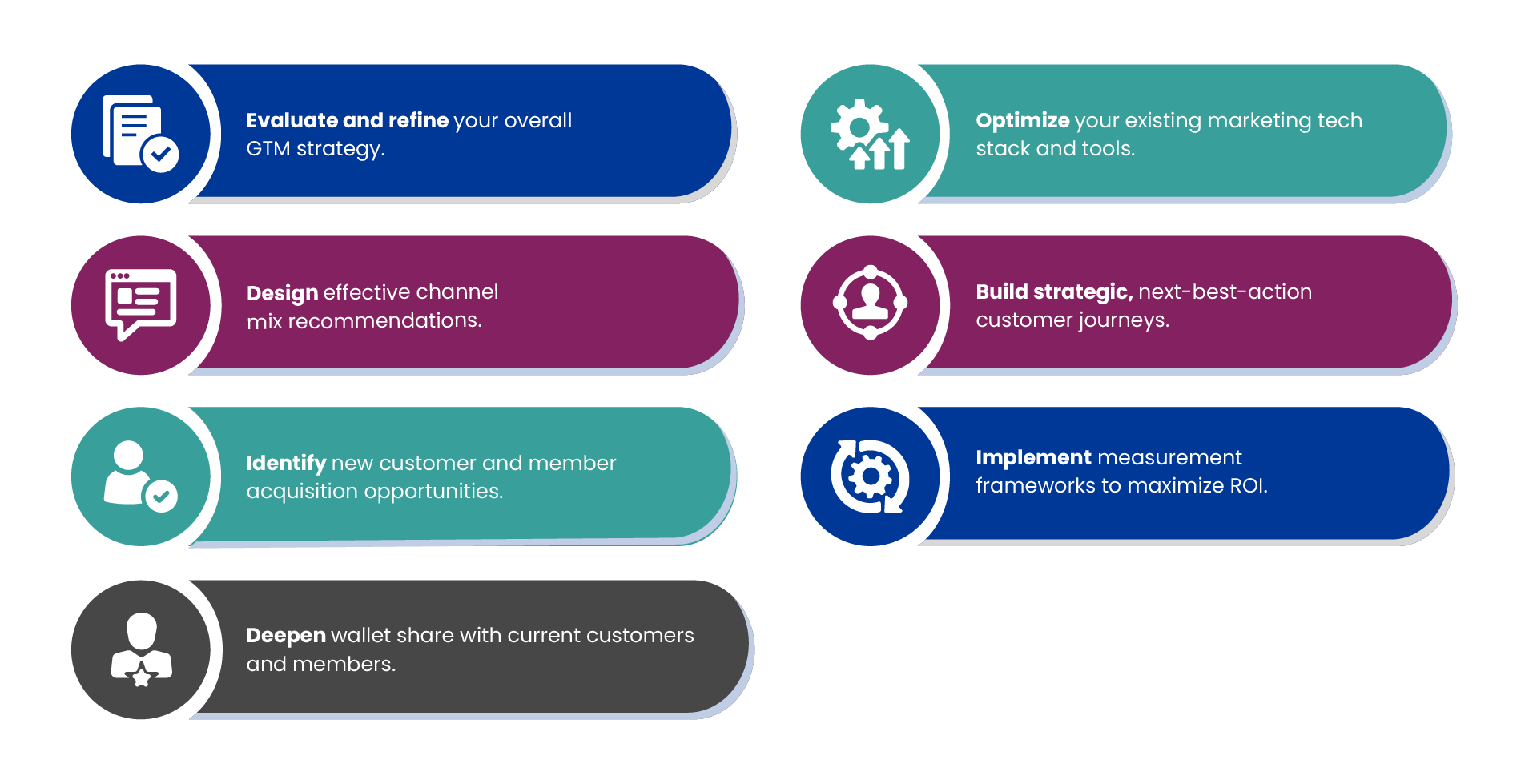
At Accelerize360, our team of experts has worked with over 200 community financial institutions to support them in their various journeys, providing strategic recommendations that accelerate growth and increase return on marketing spend. Our GTM strategy experts can help your institution:
If your institution is navigating these challenges and evaluating what comes next, we invite you to connect with Accelerize360. Let’s discuss how the right data, insights, and strategy can help your organization remain resilient, customer-focused, and prepared for the future.
Subscribe for the latest insights and blog updates. Stay ahead with us!
Subscribe Now